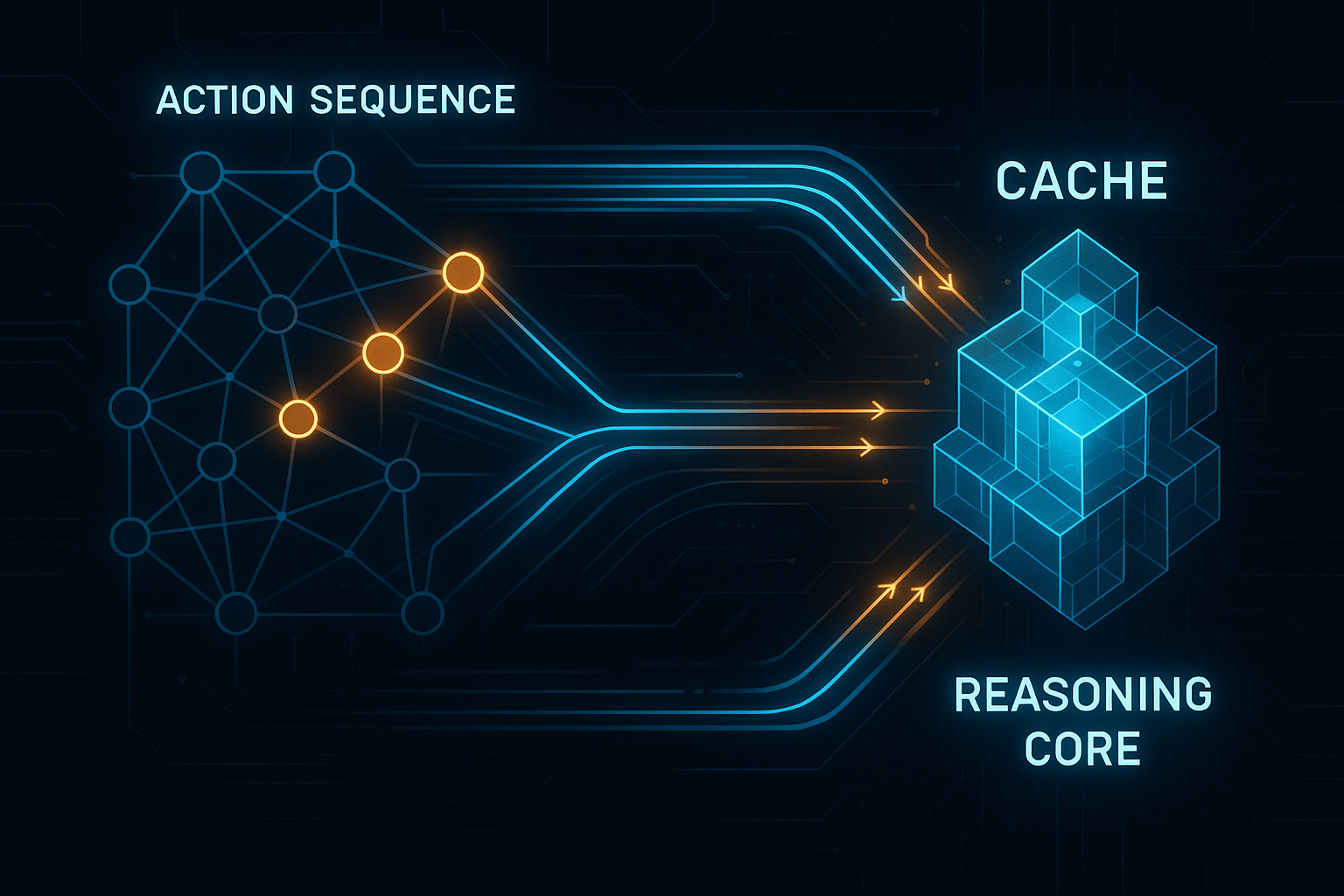
AI Agent Behavior Caching: The Muscle Memory Edge
Your AI agents are re-thinking every decision from scratch. Every. Single. Time. That's like hiring a surgeon who forgets how to make an incision between patients. Behavior caching is how you fix that — and right now, teams who get this are running agents 10x cheaper and 5x faster than everyone else.
This pattern is blowing up on Hacker News for a reason. As agentic workloads scale from prototypes into production, the economics of re-running full LLM reasoning chains for repetitive sub-tasks become brutal. Behavior caching is the emerging answer: capture, store, and replay proven action sequences so your agents develop something like muscle memory.
Let me break down exactly what's happening, why it matters right now, and how to implement it before your competitors do.
Why This Is Blowing Up Right Now
Three forces converged at once:
- Agent loops are getting longer. Multi-step agents running 20–50 tool calls per task are now normal. The token cost compounds fast.
- Repetition is everywhere. Real production agents hit the same sub-task patterns constantly — authenticate, parse this schema, navigate this UI flow, format this output. Reasoning from scratch every time is waste.
- Prompt caching infrastructure matured. Anthropic's prompt caching, OpenAI's cached completions, and open-source solutions like
semantic-routerandZepgave engineers actual primitives to work with.
The insight that's spreading: not all agent decisions need LLM reasoning. Some of them just need fast lookup. Behavior caching draws that line deliberately instead of letting it happen accidentally.
What Behavior Caching Actually Means
Don't confuse this with prompt caching (reusing a static system prompt prefix) or RAG (retrieving documents). Behavior caching is about storing action sequences — the full chain of decisions + tool calls that solved a specific class of problem — and replaying them when a semantically similar situation recurs.
Think of it in three layers:
| Layer | What Gets Cached | Replay Trigger |
|---|---|---|
| Prompt Cache | Token prefixes | Exact string match |
| Semantic Cache | LLM responses | Embedding similarity |
| Behavior Cache | Action sequences + outcomes | Intent + context similarity |
The behavior cache is the highest-value layer because it skips reasoning entirely for known-good workflows. The agent observes the situation, matches it to a cached behavior pattern, executes deterministically, and only escalates to full LLM reasoning when confidence is low.
The Architecture: How to Build It
Here's the pattern that's emerging in production systems. You need four components:
- Behavior recorder — captures successful action sequences with their triggering context
- Intent encoder — embeds the situation into a vector for similarity matching
- Behavior store — vector DB + structured storage for the action sequences
- Replay engine — retrieves, validates, and executes cached behaviors
Let's build a minimal version. I'll use Python with LangChain tooling, but the pattern works with any agent framework.
Step 1: The Behavior Recorder
import json
import hashlib
from datetime import datetime
from typing import Any
from dataclasses import dataclass, field

@dataclass
class BehaviorRecord:
    behavior_id: str
    intent_summary: str          # natural language description of the situation
    context_snapshot: dict       # relevant state at decision time
    action_sequence: list[dict]  # ordered list of tool calls + params
    outcome: dict                # what happened: success, output, side effects
    success_count: int = 1
    failure_count: int = 0
    last_used: str = field(default_factory=lambda: datetime.utcnow().isoformat())
    confidence_score: float = 1.0

class BehaviorRecorder:
    def __init__(self, store):
        self.store = store

    def record(self, intent: str, context: dict, actions: list[dict], outcome: dict) -> str:
        """Record a completed agent behavior sequence."""
        behavior_id = hashlib.sha256(
            f"{intent}{json.dumps(context, sort_keys=True)}".encode()
        ).hexdigest()[:16]

        record = BehaviorRecord(
            behavior_id=behavior_id,
            intent_summary=intent,
            context_snapshot=context,
            action_sequence=actions,
            outcome=outcome
        )

        self.store.upsert(record)
        print(f"[BehaviorRecorder] Stored behavior {behavior_id}: {intent[:60]}")
        return behavior_id
Step 2: Intent Encoder + Similarity Matching
from openai import OpenAI
import numpy as np

client = OpenAI()

def encode_intent(intent: str, context: dict) -> list[float]:
    """Encode agent situation into a vector for similarity search."""
    # Combine intent with key context signals
    context_signals = " ".join([
        f"{k}={v}" for k, v in context.items()
        if k in ("task_type", "tool_available", "data_schema", "environment")
    ])
    text = f"INTENT: {intent} | CONTEXT: {context_signals}"

    response = client.embeddings.create(
        model="text-embedding-3-small",
        input=text
    )
    return response.data[0].embedding

def cosine_similarity(a: list[float], b: list[float]) -> float:
    a_arr, b_arr = np.array(a), np.array(b)
    return float(np.dot(a_arr, b_arr) / (np.linalg.norm(a_arr) * np.linalg.norm(b_arr)))
Step 3: The Cache Lookup + Replay Engine
class BehaviorCacheEngine:
    REPLAY_THRESHOLD = 0.92   # similarity score to trigger replay
    FALLBACK_THRESHOLD = 0.75  # similarity score to use as hint only

    def __init__(self, store, recorder: BehaviorRecorder):
        self.store = store
        self.recorder = recorder

    def lookup(self, intent: str, context: dict) -> dict:
        """
        Returns:
          {'mode': 'replay', 'behavior': BehaviorRecord}  -> execute cached sequence
          {'mode': 'hint', 'behavior': BehaviorRecord}    -> use as starting point
          {'mode': 'reason', 'behavior': None}            -> full LLM reasoning
        """
        query_vector = encode_intent(intent, context)
        candidates = self.store.search(query_vector, top_k=3)

        if not candidates:
            return {"mode": "reason", "behavior": None}

        best = candidates[0]
        similarity = cosine_similarity(query_vector, best.embedding)

        print(f"[BehaviorCache] Best match similarity: {similarity:.3f} for '{best.intent_summary[:50]}'")

        if similarity >= self.REPLAY_THRESHOLD and best.confidence_score > 0.8:
            return {"mode": "replay", "behavior": best}
        elif similarity >= self.FALLBACK_THRESHOLD:
            return {"mode": "hint", "behavior": best}
        else:
            return {"mode": "reason", "behavior": None}

    def execute_cached(self, behavior: BehaviorRecord, tools: dict) -> dict:
        """Replay a cached action sequence against live tools."""
        results = []
        try:
            for step in behavior.action_sequence:
                tool_name = step["tool"]
                tool_args = step["args"]

                if tool_name not in tools:
                    raise ValueError(f"Tool '{tool_name}' not available for replay")

                result = tools[tool_name](**tool_args)
                results.append({"tool": tool_name, "result": result})

            # Update success stats
            behavior.success_count += 1
            behavior.last_used = datetime.utcnow().isoformat()
            self.store.upsert(behavior)

            return {"success": True, "results": results, "source": "behavior_cache"}

        except Exception as e:
            # Penalize confidence on failure
            behavior.failure_count += 1
            behavior.confidence_score = behavior.success_count / (
                behavior.success_count + behavior.failure_count
            )
            self.store.upsert(behavior)
            return {"success": False, "error": str(e), "source": "behavior_cache"}
Step 4: Wrapping Your Agent Loop
class CachingAgentWrapper:
    def __init__(self, base_agent, cache_engine: BehaviorCacheEngine):
        self.agent = base_agent
        self.cache = cache_engine

    def run(self, task: str, context: dict, tools: dict) -> dict:
        # 1. Check behavior cache first
        lookup = self.cache.lookup(task, context)

        if lookup["mode"] == "replay":
            print(f"[Agent] CACHE HIT — replaying behavior {lookup['behavior'].behavior_id}")
            result = self.cache.execute_cached(lookup["behavior"], tools)
            if result["success"]:
                return result  # Done. No LLM call needed.
            print("[Agent] Cache replay failed, falling back to full reasoning")

        # 2. Hint mode: seed agent with prior behavior as context
        hint_context = ""
        if lookup["mode"] == "hint" and lookup["behavior"]:
            prior = lookup["behavior"]
            hint_context = f"\
\
Previously solved a similar task with: {json.dumps(prior.action_sequence)}"
            print(f"[Agent] CACHE HINT — providing prior behavior as context")

        # 3. Full LLM reasoning
        action_log = []
        outcome = self.agent.run(task + hint_context, context, action_log)

        # 4. Record the new behavior if successful
        if outcome.get("success"):
            self.cache.recorder.record(
                intent=task,
                context=context,
                actions=action_log,
                outcome=outcome
            )

        return outcome
This wrapper gives you the full decision tree: replay → hint → reason. Your LLM calls only fire when genuinely necessary.
The Economics: Why This Changes Everything
Let's be concrete. Consider an agent handling customer support automation that runs 1,000 tasks per day. Typical breakdown after caching:
- ~60% of tasks: cache replay — zero LLM calls, ~5ms execution
- ~25% of tasks: hint mode — 1 LLM call instead of 4–8, ~40% token reduction
- ~15% of tasks: full reasoning — normal cost, but generates new cache entries
On GPT-4o at current pricing, that's roughly a 70% cost reduction on a mature cache. Latency drops comparably. This is why teams running agents at scale are treating behavior caching as infrastructure, not optimization.
For deeper cost strategies, check out reducing OpenAI API costs without sacrificing quality — behavior caching stacks directly on top of those techniques.
The Failure Modes You Need to Know
Behavior caching is powerful but it introduces new ways to break things. Watch for these:
1. Stale Behavior Poisoning
A cached behavior was correct when recorded but the environment changed — the API schema updated, the UI flow changed, the upstream data format shifted. Your confidence scoring (success/failure ratio) catches this eventually, but you need proactive TTL policies too. Set a max_age on high-stakes behaviors and force re-verification.
2. Semantic Drift in Lookup
Two tasks sound similar in embedding space but have meaningfully different contexts. A threshold of 0.92 is conservative for a reason — tune it upward if you're seeing false replay matches. Add explicit context keys (environment, schema version, user tier) to your intent encoding to sharpen discrimination.
3. Cache Entrenchment
A suboptimal behavior gets cached early and keeps getting replayed, blocking discovery of better approaches. Implement a periodic exploration mode where a small percentage of cache-hit situations get sent to full reasoning anyway — similar to epsilon-greedy in reinforcement learning.
This connects directly to the safety patterns we covered in AI agent production safety. The same principles apply: never let automation outrun your ability to inspect and override it.
Where This Fits in Your Stack
Behavior caching slots in between your agent's working memory and its long-term memory. If you've read our piece on AI agent memory and persistent sandbox infrastructure, think of behavior caching as a specialized procedural memory layer — distinct from episodic memory (what happened) and semantic memory (what things mean).
For your vector storage layer, any of the options from our vector database comparison will work. Chroma is fine for development, Weaviate or Pinecone for production scale. The behavior records themselves should live in structured storage (Postgres, Redis) with only the embedding vectors in the vector DB.
If you're building agents with LangGraph, behavior caching integrates cleanly as a node in your graph that intercepts before the reasoning node fires. If you're using raw function calling patterns, the wrapper approach above drops in with minimal changes — see our GPT-4 function calling guide for the underlying mechanics.
What to Build This Week
Here's your action sequence, no pun intended:
- Audit your agent's action logs. Find the top 10 most repeated sub-task patterns. Those are your first cache candidates.
- Instrument your agent to log complete action sequences with outcomes. You need this data before you can cache anything.
- Stand up a simple vector store (Chroma locally) and implement the encoder + lookup. Start with a high threshold (0.95) and lower it as you gain confidence.
- Add confidence tracking immediately. You want the cache to self-heal when behaviors go stale, not silently degrade.
- Measure the cache hit rate after one week. If it's below 20%, your similarity threshold is too tight or your context encoding needs more discriminating signals.
The teams shipping this right now aren't doing anything magical. They're just treating agent behavior as a first-class artifact worth preserving and reusing — the same discipline we've applied to functions, APIs, and databases for decades.
Your agents are doing smart things every day. Stop making them forget.