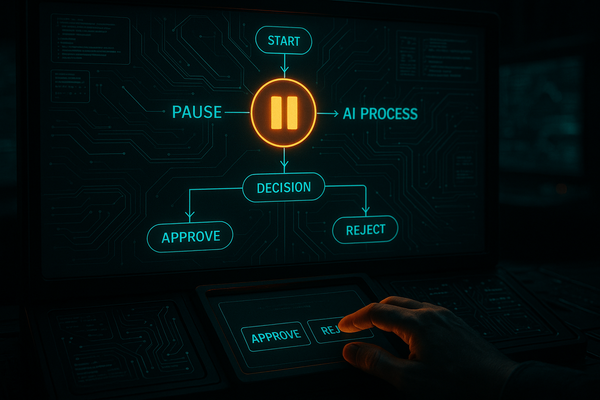
Your team ships an AI feature. It works great in testing. Then production hits and you discover the model systematically underperforms for a specific demographic, leaks patterns from training data under certain prompts, or makes confident wrong decisions nobody can explain. Legal is calling. Users are angry. The post-mortem is brutal.
This isn't a hypothetical. It's what happens when teams treat responsible AI as someone else's problem — a checkbox for compliance or a footnote in the README. The teams that avoid these disasters don't have more ethics PhDs. They have a working framework embedded into how they actually build.
Here's that framework, built from real production experience.
Why Most "AI Ethics" Efforts Fail Teams
The word "ethics" sends engineers reaching for their headphones. It sounds abstract, unactionable, and like it belongs in a policy document rather than a sprint. That's the first problem.
The second problem: most responsible AI guidance is written for enterprises with dedicated AI governance teams. If you're a startup or a product team inside a larger org, you need something you can actually run with your existing people, your existing process, and your existing stack.
A responsible AI framework isn't about moral philosophy. It's about risk engineering. What can go wrong? How do you detect it? How do you respond? That framing makes it tractable for any engineering team.
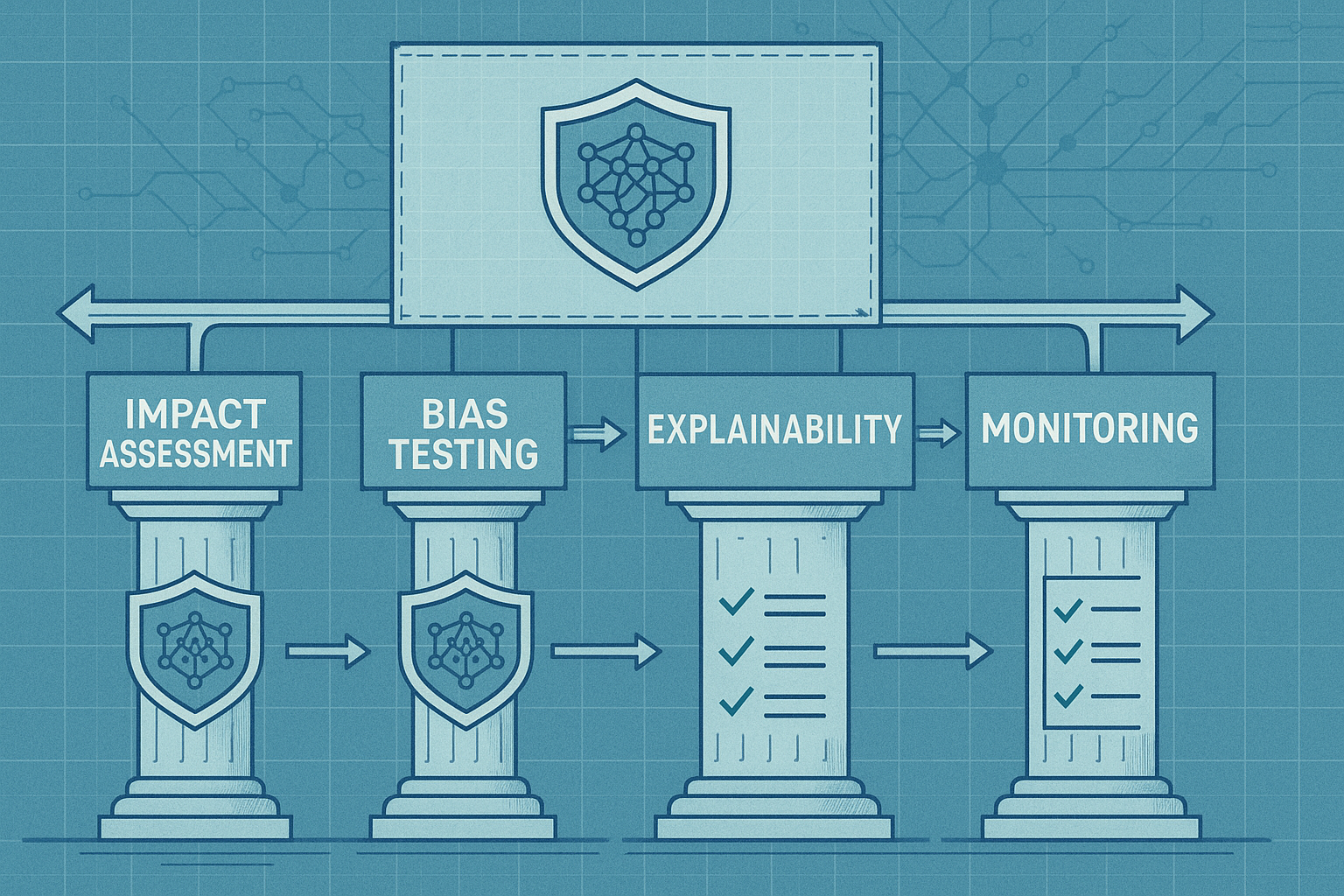
The Four Pillars of a Practical Responsible AI Framework
1. Impact Assessment Before You Build
Before writing a line of code, answer five questions about the AI feature you're building:
- Who makes decisions based on this output? Humans reviewing AI suggestions vs. automated pipelines have very different risk profiles.
- What's the worst realistic outcome if the model is wrong? Wrong movie recommendation vs. wrong loan decision are not equivalent.
- Which user groups might experience this differently? Think age, language, geography, access needs.
- What data is this model touching, directly or indirectly? PII, behavioral data, proprietary content.
- Is there a meaningful way for users to contest or override the AI?
This doesn't need to be a 40-page document. A filled-out one-page template in your project repo is enough. The act of answering these questions surfaces assumptions your team is making that need to be tested, not just shipped.
For teams building autonomous agents — where the AI is taking actions rather than just generating content — the stakes are higher and the assessment needs to be proportionally more rigorous. Our guide on AI agent production safety covers the specific failure modes to assess for agentic systems.
2. Fairness and Bias Testing as a First-Class Concern
Bias testing is where most teams either skip entirely or do performatively. Here's a minimum viable approach that actually catches problems:
Disaggregated evaluation: Don't just track aggregate accuracy metrics. Split your evaluation set by every dimension that matters for your use case — demographic attributes, input language, device type, account age — and measure performance separately for each slice.
# Minimum viable disaggregated eval
import pandas as pd
from sklearn.metrics import accuracy_score

def evaluate_by_slice(df, prediction_col, label_col, slice_col):
    """
    Evaluate model performance across different data slices.
    Surfaces disparate impact before it hits production.
    """
    results = {}

    # Overall baseline
    results['overall'] = accuracy_score(df[label_col], df[prediction_col])

    # Per-slice performance
    for slice_value in df[slice_col].unique():
        slice_df = df[df[slice_col] == slice_value]
        results[f'slice_{slice_value}'] = accuracy_score(
            slice_df[label_col],
            slice_df[prediction_col]
        )

    # Flag slices that deviate significantly from overall
    threshold = 0.10  # 10% degradation triggers review
    flagged = {
        k: v for k, v in results.items()
        if k != 'overall' and (results['overall'] - v) > threshold
    }

    return results, flagged

# Example usage
results, flagged_slices = evaluate_by_slice(
    eval_df,
    prediction_col='model_output',
    label_col='ground_truth',
    slice_col='user_region'
)

if flagged_slices:
    print(f"WARNING: Performance gaps detected: {flagged_slices}")
    # This should block deployment or trigger human review
Adversarial prompt testing: For LLM-based features, build a suite of adversarial inputs that probe for stereotyping, refusal inconsistencies, and output quality differences across groups. Run this suite on every model version change, not just at initial launch.
Red-teaming cadence: Schedule a quarterly session where team members actively try to break the system — find the inputs that produce harmful, embarrassing, or discriminatory outputs. Document findings and track remediation. This is especially important if you're using prompt engineering to customize LLM behavior, where the interaction between your prompt and the base model can produce unexpected behaviors. See our deep dive on prompt engineering for agentic workflows for patterns that reduce these risks.
3. Transparency and Explainability Standards
You don't need to explain every transformer attention weight. You need to answer a practical question: when the AI makes a consequential decision, can an affected user understand why?
Define three tiers of explainability requirement for your features:
| Tier | Use Case Examples | Minimum Explainability |
|---|---|---|
| Low stakes | Content recommendations, autocomplete | "Based on your history" is sufficient |
| Medium stakes | Search ranking, content moderation flags | Key factors shown, appeal mechanism available |
| High stakes | Credit, hiring, medical, legal | Specific factors with weights, human review path required |
For RAG-based systems — where model outputs are grounded in retrieved documents — you get explainability almost for free by surfacing the source documents alongside the answer. This is one of the underrated safety benefits of the RAG pattern. Our walkthrough on building RAG systems from scratch shows how to structure retrieval to make attribution clean.
Logging is the foundation of explainability at scale. Every consequential AI decision should be logged with enough context to reconstruct why the model produced that output: the input, the model version, the retrieved context if applicable, and the output. This isn't just for debugging — it's what allows you to respond when a user disputes a decision.
4. Ongoing Monitoring and Incident Response
Most responsible AI frameworks focus on pre-deployment. The real action is post-deployment. Models drift. Data distributions shift. Users find edge cases your testing never covered. New attack vectors emerge.
Your monitoring stack for a responsible AI system needs three components:
Output quality monitoring: Track not just latency and error rates, but output distribution. If your model's sentiment scores suddenly skew negative, if confidence scores drop, if output length increases sharply — these are signals that something changed. Setting up anomaly detection on model outputs is as important as monitoring your infrastructure.
# Lightweight output quality monitor
from collections import deque
import statistics

class OutputQualityMonitor:
    """
    Track rolling statistics on model outputs.
    Alerts when distribution shifts significantly.
    """
    def __init__(self, window_size=1000, alert_threshold=2.0):
        self.window = deque(maxlen=window_size)
        self.alert_threshold = alert_threshold  # std deviations
        self.baseline_mean = None
        self.baseline_std = None

    def set_baseline(self, historical_scores: list):
        """Establish baseline from known-good period."""
        self.baseline_mean = statistics.mean(historical_scores)
        self.baseline_std = statistics.stdev(historical_scores)

    def record_output(self, quality_score: float) -> dict:
        """Record output and check for distribution shift."""
        self.window.append(quality_score)

        if len(self.window) < 100 or not self.baseline_mean:
            return {"status": "collecting"}

        recent_mean = statistics.mean(self.window)
        deviation = abs(recent_mean - self.baseline_mean) / self.baseline_std

        if deviation > self.alert_threshold:
            return {
                "status": "alert",
                "message": f"Output distribution shifted {deviation:.1f} std devs from baseline",
                "recent_mean": recent_mean,
                "baseline_mean": self.baseline_mean
            }

        return {"status": "ok", "recent_mean": recent_mean}

monitor = OutputQualityMonitor()
# Call monitor.record_output(score) for each model response
# Integrate with your alerting system (PagerDuty, Slack, etc.)
User feedback loops: Build explicit mechanisms for users to flag AI outputs as wrong, harmful, or confusing. Even a simple thumbs down button, if you actually review the flagged outputs weekly, surfaces issues faster than automated monitoring alone.
Incident response playbook: Define in advance what happens when a problem is discovered. Who gets notified? What triggers a feature rollback vs. a model version rollback vs. a prompt update? What's the SLA for user-facing communication? Having this documented before an incident means you're not making these decisions under pressure. The patterns from general LLM production deployment apply directly here.
Making the Framework Stick: Process Integration
A framework that lives in a document nobody reads is useless. Here's how to embed responsible AI practices into your actual engineering process:
Add AI impact assessment to your definition of ready: A ticket isn't ready for development until the impact assessment is complete. Not a separate process — part of the same ticket template.
Include bias tests in your CI pipeline: Your automated test suite should run disaggregated evaluation on a standard holdout set for every model change. Failing this blocks deployment, same as failing unit tests.
Assign a responsible AI reviewer for production AI features: This doesn't have to be a dedicated role. Rotate it among senior engineers. Their job is to ask the hard questions during code review: is logging sufficient? Is there a user appeal path? Has the bias test suite run?
Run a responsible AI retrospective quarterly: 30 minutes. What near-misses did we have? What monitoring gaps did we discover? What's improved? What's still a gap? Keep it short, keep it honest, keep it recurring.
The Minimum Viable Responsible AI Stack
If you're starting from zero, implement in this order:
- Week 1: Impact assessment template in your project repo. Fill it out for every current AI feature.
- Week 2: Comprehensive logging for all AI decisions in production. Input, output, model version, timestamp.
- Week 3: Disaggregated evaluation on your next model evaluation run. Identify and document any gaps.
- Month 2: User feedback mechanism live. Weekly review process established.
- Month 3: CI integration for bias tests. Incident response playbook written and reviewed.
This isn't the full picture of responsible AI — that includes supply chain questions about your model providers, data governance, legal compliance, and more. But this stack addresses the most common failure modes that teams actually encounter in production.
Practical Takeaways
- Frame responsible AI as risk engineering, not ethics philosophy — it becomes tractable and actionable for any team.
- Impact assessment before build surfaces assumptions that should be tested, not shipped.
- Disaggregated evaluation is non-negotiable — aggregate metrics hide the disparate impact problems that create real harm.
- Explainability requirements scale with stakes — don't over-engineer low-stakes features, do engineer high-stakes ones properly.
- Post-deployment monitoring matters as much as pre-deployment testing — models drift, users find edge cases, attack vectors evolve.
- The framework only works if it's embedded in process — definition of ready, CI pipeline, code review checklist, quarterly retro.
Responsible AI isn't a tax on shipping fast. Done right, it's a risk management practice that makes you faster in the long run — because you're catching problems before they become incidents, not after.