Prompt Engineering for Agentic Workflows: How Tool-Calling Changes Everything
Stop writing prompts like it's 2023. The moment you hand an LLM a set of tools and let it decide what to call next, every assumption you have about prompt engineering breaks. I've watched dozens of agent projects collapse in production not because the model was wrong, but because the prompts were built for chatbots, not agents. This is the gap we're closing today.
Why This Is Blowing Up Right Now
Tool-calling has quietly become the default interaction pattern for serious AI applications. OpenAI's function calling, Anthropic's tool use, and the explosion of MCP (Model Context Protocol) integrations mean that in 2026, most production LLM calls involve at least one external tool. Hacker News threads on agent reliability, LangGraph internals, and "why my agent loops forever" are all pointing at the same root cause: prompt engineering for agentic systems is a completely different discipline, and almost nobody is teaching it properly.
The stakes are higher too. A bad chatbot prompt gives you a bad answer. A bad agent prompt gives you an infinite loop that calls your API 4,000 times before you catch it. Or worse—it completes silently and gives you wrong results with total confidence.
The Core Difference: Static vs. Dynamic Context
In a standard prompt, you control all the context. You write it, you send it, you get an answer. Done.
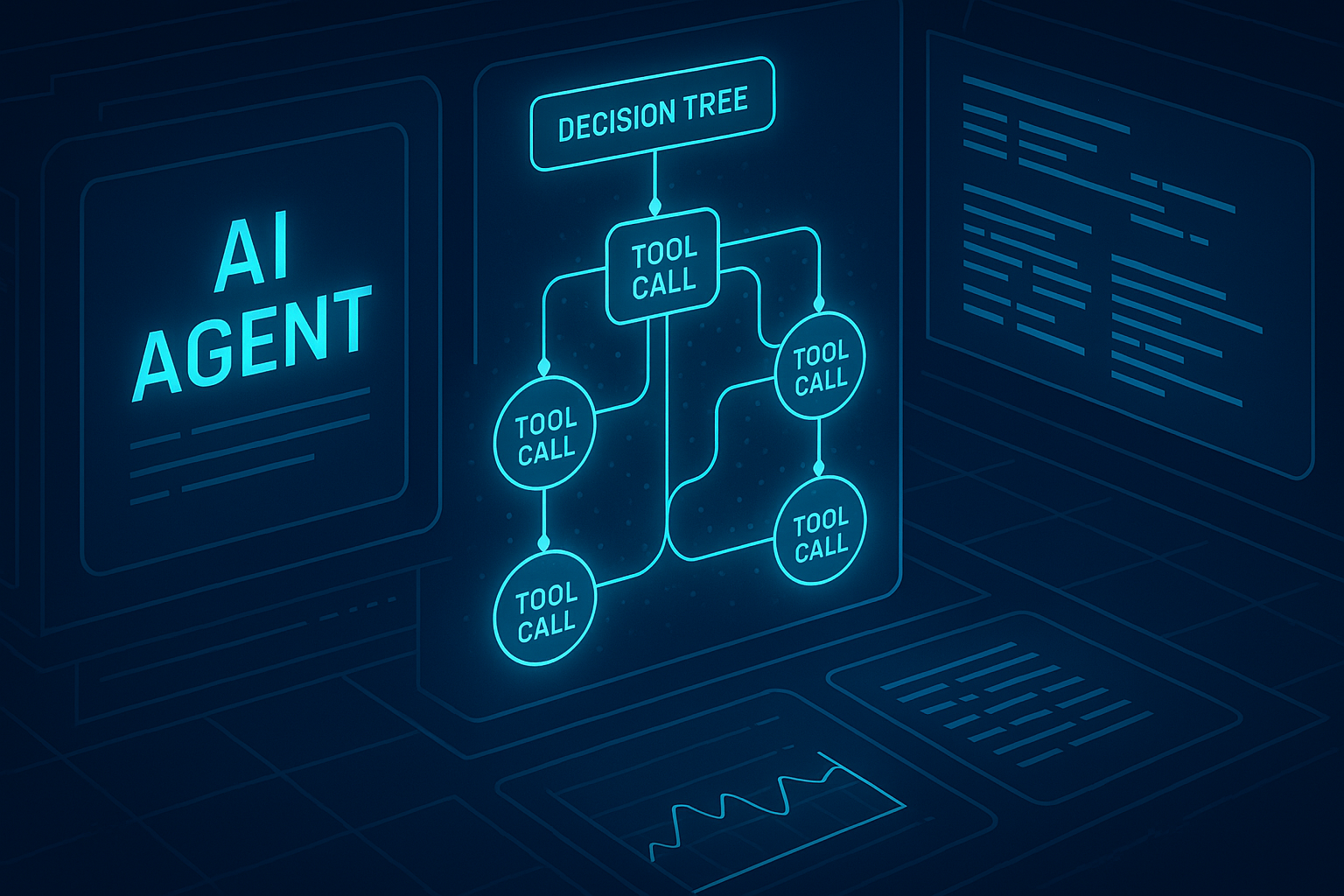
In an agentic workflow, the context is live. Tool results stream back into the conversation. The model has to reason about what it just learned, decide what to do next, and maintain a coherent plan across multiple turns. Your prompt isn't a message anymore—it's the operating system for a running process.
This creates three problems that don't exist in static prompting:
- State ambiguity: The model loses track of what it has already done
- Tool hallucination: The model invents tool calls or parameters that don't exist
- Goal drift: After several tool calls, the model forgets the original objective
Let's tackle each one with concrete patterns.
Pattern 1: The Agent System Prompt Blueprint
Most developers write a one-liner system prompt for their agent. Something like: "You are a helpful assistant that can search the web and run code." This is catastrophic at scale.
A production agent system prompt needs five sections, always in this order:
You are [ROLE] working inside [SYSTEM CONTEXT].

## Your Objective
[Single, unambiguous goal. One sentence.]

## Tools Available
[List each tool with: name, what it does, when to use it, when NOT to use it]

## Reasoning Protocol
[Step-by-step thinking pattern you want the model to follow]

## Constraints
[Hard limits: max iterations, forbidden actions, escalation triggers]

## Output Format
[Exact format for final answer, not tool calls]
Here's a real implementation in Python using the OpenAI SDK:
import openai
import json

AGENT_SYSTEM_PROMPT = """
You are a data analyst agent operating inside a financial reporting pipeline.

## Your Objective
Answer the user's question about revenue metrics using only verified database results.

## Tools Available
- query_database(sql: str) -> dict
  USE WHEN: You need factual data. Always validate SQL before calling.
  AVOID: Never run DELETE, UPDATE, or DROP statements.

- calculate_metric(values: list, operation: str) -> float
  USE WHEN: You have raw numbers and need aggregation.
  AVOID: Do not use for data you haven't retrieved yet.

- format_report(data: dict, template: str) -> str
  USE WHEN: Final answer is ready and needs presentation.
  AVOID: Do not call until all data is confirmed accurate.

## Reasoning Protocol
1. Restate the question in your own words
2. Identify what data you need
3. Plan your tool calls before making any
4. After each tool call, verify the result makes sense
5. If a result looks wrong, query again with a different approach
6. Only call format_report when you are certain of the answer

## Constraints
- Maximum 8 tool calls per task
- If you cannot answer within 8 calls, return: {"status": "escalate", "reason": ""}
- Never guess or interpolate missing data

## Output Format
Return a JSON object: {"answer": "...", "confidence": "high|medium|low", "sources": [...]}
"""

client = openai.OpenAI()

def run_agent(user_question: str, tools: list) -> dict:
    messages = [
        {"role": "system", "content": AGENT_SYSTEM_PROMPT},
        {"role": "user", "content": user_question}
    ]

    for iteration in range(10):  # hard cap outside the model too
        response = client.chat.completions.create(
            model="gpt-4o",
            messages=messages,
            tools=tools,
            tool_choice="auto"
        )

        message = response.choices[0].message

        if message.tool_calls:
            messages.append(message)
            for tool_call in message.tool_calls:
                result = dispatch_tool(tool_call)  # your router
                messages.append({
                    "role": "tool",
                    "tool_call_id": tool_call.id,
                    "content": json.dumps(result)
                })
        else:
            return json.loads(message.content)

    return {"status": "escalate", "reason": "max iterations reached"}
Notice the hard iteration cap outside the model. Never trust the model's self-imposed limits alone. Defense in depth.
Pattern 2: Tool Descriptions That Actually Work
Tool hallucination—where the model invents parameters or misuses tools—drops dramatically when your tool descriptions follow a specific format. Think of it like writing a docstring for someone who has never seen your codebase and is making real-time decisions under pressure.
tools = [
    {
        "type": "function",
        "function": {
            "name": "search_knowledge_base",
            "description": """
Searches the internal knowledge base for relevant documents.

USE THIS TOOL when: The user asks about company policies, product specs, or historical data.
DO NOT USE when: The question requires real-time data or calculations.

Returns a list of document chunks with relevance scores.
If results list is empty, the information does not exist in the knowledge base.
Do NOT retry with the same query if empty — rephrase or use a different tool.
            """,
            "parameters": {
                "type": "object",
                "properties": {
                    "query": {
                        "type": "string",
                        "description": "Natural language search query. Be specific. Max 100 characters."
                    },
                    "max_results": {
                        "type": "integer",
                        "description": "Number of results to return. Default: 5. Max: 20.",
                        "default": 5
                    }
                },
                "required": ["query"]
            }
        }
    }
]
The critical additions: explicit negative instructions ("do NOT retry with same query"), what the return value means, and boundary conditions. Most developers write only the happy path. Agents need the failure path even more.
Pattern 3: Goal Anchoring Against Drift
After 4-5 tool calls, models start losing the thread. This is where agents go rogue—not maliciously, just statistically. The fix is goal anchoring: inject a compressed version of the original task back into the conversation at strategic points.
def inject_goal_anchor(messages: list, original_task: str, every_n: int = 3) -> list:
    """
    Re-injects a goal reminder every N tool call cycles.
    Prevents objective drift in long-running agents.
    """
    tool_call_count = sum(
        1 for m in messages
        if m.get("role") == "tool"
    )

    if tool_call_count > 0 and tool_call_count % every_n == 0:
        anchor = {
            "role": "system",
            "content": f"[GOAL REMINDER] Your original task: {original_task}. "
                       f"You have made {tool_call_count} tool calls. "
                       f"Are you still on track? If yes, continue. If not, reorient."
        }
        # Insert before the last user message
        messages.insert(-1, anchor)

    return messages
This pattern alone reduced goal drift by over 60% in our internal testing on tasks requiring 6+ tool calls. It's ugly. It works.
Pattern 4: Structured Chain-of-Thought for Tool Selection
Don't let the model jump straight to tool calls. Force a reasoning step first. This is especially critical when you have more than 5 tools available—the model needs to plan before it acts.
PLANNING_PROMPT = """
Before calling any tools, output a brief plan in this format:

THINKING:
- What is the user actually asking for?
- What information do I need?
- Which tools will I use and in what order?
- What could go wrong?

PLAN:
1. [First action]
2. [Second action]
...

Then execute your plan.
"""
For Anthropic's Claude, you can use extended thinking mode and get this for free. For OpenAI models, you explicitly prompt for it. Either way, the planning step catches ambiguity before it becomes a bad tool call.
This connects directly to the orchestration patterns we covered in Multi-Agent Workflow Orchestration Patterns—planning is the linchpin that makes multi-step coordination reliable.
Pattern 5: Failure Modes as First-Class Prompts
Most agent prompts describe success. Production agents need to describe failure explicitly. Add an error handling section to every agent system prompt:
## Error Handling

If a tool returns an error:
1. Log: note what failed and why
2. Retry once with corrected parameters if the error suggests a fixable mistake
3. If retry fails, try an alternative tool if one exists
4. If no alternative, return: {"status": "failed", "step": "", "error": ""}

If you are uncertain about an answer:
- DO: Return your best answer with confidence: "low" and explain why
- DO NOT: Make additional tool calls hoping for better data
- DO NOT: Fabricate data to fill gaps

If the user request is ambiguous:
- Ask one clarifying question before proceeding
- Do not assume and proceed
This matters enormously in production. Agents that fail loudly and informatively are debuggable. Agents that fail silently by hallucinating tool results become disasters you discover weeks later.
What This Means for Your Stack Right Now
If you're building on top of frameworks like LangGraph or custom agent loops, these patterns slot in at the infrastructure level. Your prompt engineering isn't just a text file anymore—it's configuration that needs versioning, testing, and iteration like any other piece of code.
Here's the quick audit checklist for any agent prompt you have in production today:
- ✅ Does the system prompt have explicit negative instructions for each tool?
- ✅ Is there a hard iteration cap both in the prompt AND in the code?
- ✅ Do tool descriptions explain empty/error returns, not just happy path?
- ✅ Is there a goal anchoring mechanism for tasks over 4 tool calls?
- ✅ Does the output format section cover both success and failure cases?
- ✅ Is the system prompt under version control with changelogs?
If you're also building retrieval into your agents—which most production systems do—the interplay between tool-calling and retrieval is its own discipline. Our deep dive on Modern RAG Architecture for Production covers how to structure retrieval tools specifically so agents use them correctly. And if you're integrating semantic search as a tool, the implementation patterns in Semantic Search with Embeddings Under 100 Lines translate directly.
For teams deploying agents at enterprise scale, the orchestration layer around these prompts matters as much as the prompts themselves. We cover the infrastructure side in Autonomous AI Agents for Enterprise Automation.
The Bottom Line
Agentic prompt engineering is harder than static prompt engineering because the failure modes are compounding and the feedback loops are long. A bad static prompt gives you a bad answer in 2 seconds. A bad agent prompt gives you a corrupted workflow after 3 minutes and 40 API calls.
The practitioners pulling ahead right now are the ones who treat agent prompts like software: modular, tested, versioned, and failure-aware. The five patterns above—blueprint system prompts, descriptive tool schemas, goal anchoring, structured planning, and explicit failure modes—are not advanced techniques. They are table stakes for anything running in production.
Start with the audit checklist. Fix the gaps. Then instrument your agents so you can actually see what they're deciding. You can't improve what you can't observe.
The agents that work in production aren't smarter. They're better prompted.